
Desirable Futures: Write Me a Letter
DOI :
https://doi.org/10.14288/acme.v23i2.2318Mots-clés :
anticolonial praxis, feminist methods, world building futurists, temporality, letters, futuresRésumé
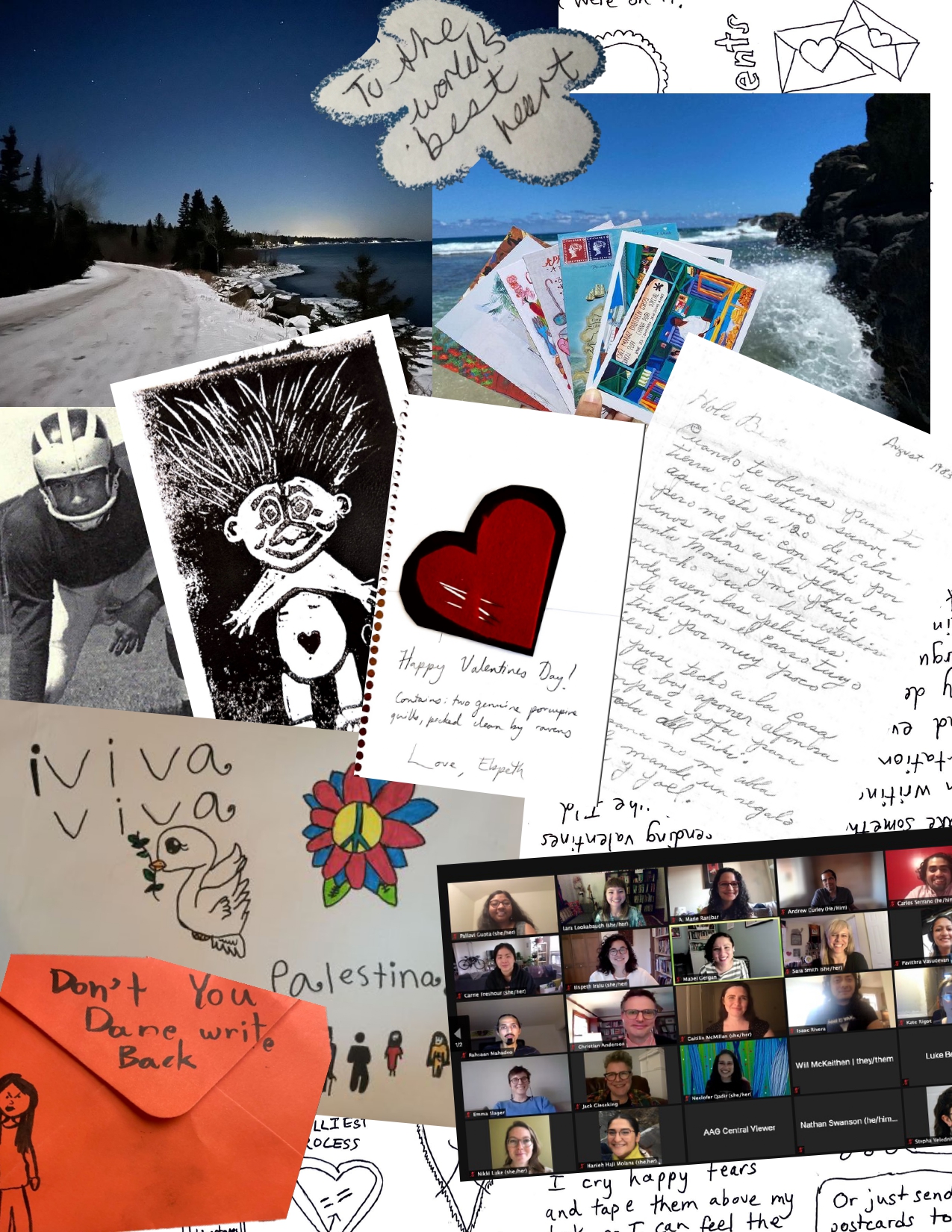
In this special issue, we propose the letter as a form with geographic potential. Building on prior work on letters in geography, Black feminism, and Indigenous studies, we draw on a collection of sixteen letters in the section to build a case for letters as time travel, anticolonial epistemology, feminist geographic method, and worldmaking praxis. We bring together letter writers who speak to their ancestors known and unknown, to future generations, to ideas, to activists, to places, and to strangers—and weave them into a messy and generative conversation on the kinds of spaces that letters make between and among us. Our intention is to build on recent work in geography to experiment with what the letter makes possible for us as geographers.
Références
Acevedo-Zapata, Diana María. 2020. “Writing as a Decolonial Feminist Praxis for Philosophical Writing.” Hypatia 35 (3): 410–23.
Bammer, Angelika, Minrose Gwin, Cindi Katz, and Elizabeth Meese. 1998. “The Place of the Letter: An Epistolary Exchange.” In Making Worlds: Gender, Metaphor, Materiality, edited by Penny M Waterstone, Sallie A Marston, Ann Brigham, and Susan Hardy Aiken, 161–202. Tucson, AZ: University of Arizona Press.
Belcourt, Billy-Ray. 2016. “A Poltergeist Manifesto.” Feral Feminisms 6: 22–32.
Cisneros, Nora Alba. 2018. “‘To My Relations’: Writing and Refusal toward an Indigenous Epistolary Methodology.” International Journal of Qualitative Studies in Education 31 (3): 188–96.
Curley, Andrew. 2021. “Infrastructures as Colonial Beachheads: Arizona’s Temporal Invasion on Diné Lands, Waters, and Resources.” Environment and Planning D: Society and Space 39 (3): 387–404.
DasGupta, Debanuj, Rae Rosenberg, John Paul Catungal, and Jen Jack Gieseking. 2021. “Pedagogies of Queer and Trans Repair.” ACME: An International Journal for Critical Geographies 20 (5): 491–508.
de Leeuw, S., 2017. Writing as righting: Truth and reconciliation, poetics, and new geo‐graphing in colonial Canada. The Canadian Geographer/Le Géographe Canadien 61(3): 306-318.
FLOCK, Feminist Geography Collective. 2021. “Making a Zine, Building a Feminist Collective.” ACME: An International Journal for Critical Geographies 20 (5): 531–61.
Fuentes, Marisa J. 2016. Dispossessed lives: Enslaved women, violence, and the archive. Philadelphia: University of Pennsylvania Press.
Gergan, Mabel, Pallavi Gupta, Lara Lookabaugh, Caitilin McMillan, Carlos Serrano, Sara Smith, and Pavithra Vasudevan. 2024. “Desirable Futures: Desirable futures: Time as possibility, practice, politics.” Environment and Planning D: Society and Space 42 (1): 1-24.
Harney, Stefano, and Fred Moten. 2013. The Undercommons: Fugitive Planning & Black Study. Brooklyn, Ny: Minor Compositions.
Kikon, Dolly, and Mabel Denzin Gergan. 2021. “Letters between a Lepcha Geographer and a Naga Anthropologist.” Raiot (blog). June 3, 2021. https://raiot.in/author/dollymabel/.
Lindsey, Treva, and Alexis Pauline Gumbs. 2021. “Preface:" Be a Mystery":(The Infinity of) Black Feminist Thought.” Feminist Studies 47 (1): 7–12.
Lorde, Audre. 1984. “An Open Letter to Mary Daly (1979).” In Sister/Outsider: Essays and Speeches, 68–69. Berkeley, CA: Ten Speed Press.
Luk, Sharon. 2018. The Life of Paper: Letters and a Poetics of Living Beyond Captivity. Berkeley: University of California Press.
Maynard, Robyn, and Leanne Betasamosake Simpson. 2022. Rehearsals for Living. Toronto: Knopf Canada.
McKittrick, Katherine. 2006. Demonic Grounds: Black Women and the Cartographies of Struggle. Minneapolis, MN: University of Minnesota Press.
Melonas, Desireé R. 2021. “‘Hey Mama;’ ‘Dear Sister;’ ‘Sister Love’: Black Women’s Healing and Radical Self-Care through Epistolary Work.” Journal of Women, Politics & Policy 42 (1): 38–57.
Molina Vargas, Hema’ny, Camila Marambio, and Nina Lykke. 2020. “Decolonising Mourning: World-Making with the Selk’nam People of Karokynka/Tierra Del Fuego.” Australian Feminist Studies 35 (104): 186–201.
Quashie, Kevin. 2021. Black Aliveness, or a Poetics of Being. Durham, NC: Duke University Press.
Simpson, Audra. 2007. “On Ethnographic Refusal: Indigeneity, ‘Voice’ and Colonial Citizenship.” Junctures: The Journal for Thematic Dialogue, no. 9: 67–80.
Simpson, Leanne Betasamosake. 2017. As We Have Always Done: Indigenous Freedom through Radical Resistance. Minneapolis: University of Minnesota Press.
Tuck, Eve. 2009. “Suspending Damage: A Letter to Communities.” Harvard Educational Review 79 (3): 409–28.
Whyte, Kyle. 2021. “Time as Kinship.” In The Cambridge Companion to Environmental Humanities, edited by Jeffrey Cohen and Stephanie Foote, 39–55. Cambridge: Cambridge University Press.
Téléchargements
Publié-e
Comment citer
Numéro
Rubrique
Licence
© Mabel Gergan, Pallavi Gupta, Lara Lookabaugh, Caitilin McMillan, Sara Smith, Pavithra Vasudevan 2024

Cette œuvre est sous licence Creative Commons Attribution - Pas d'Utilisation Commerciale - Pas de Modification 4.0 International.
Les auteur-e-s publiant dans ACME le font aux conditions de la licence canadienne Creative Commons "Attribution/Non-Commercial/No Derivative Works". En conséquence, les auteur-e-s gardent les droits sur leur texte, ainsi que celui d'être identifié-e-s comme auteur-e-s sans limitation de date. Leur texte peut être partagé librement (soit reproduit, distribué, transmis et publié) dans les conditions suivantes :
- Attribution. La publication originale de ladite oeuvre dans ACME doit être mentionnée et, pour tout usage ou distribution, les termes de sa licence doivent être précisés.
- Non commercial. L'oeuvre ne peut être utilisée à des fins commerciales.
- Pas de travaux dérivés. À l'exception d'usages légitimes dans des buts universitaires ou critiques, l'oeuvre ne peut être altérée ou transformée. À l'exception de la première condition d'attribution à ACME de la publication originale, toutes ces conditions peuvent être levées avec la permission explicite du détenteur du copyright.
(Note: du volume 1(1) au volume 7(2), les auteur-e-s ont donné à ACME un copyright sur leur article limité à la publication dans la revue. Les auteur-e-s gardent le copyright sur leur manuscrit pour toute autre forme de publication, mais doivent mentionner la publication originale dans ACME si le texte est republié ailleurs).
Pour une publication dans ACME, les auteur-e-s déclarent que et se portent garant-e-s que
- leur article est une oeuvre originale, n'a pas été publié avant et n'est pas soumis ailleurs pour publication papier ou électronique sous sa forme finale ;
- Illes ont obtenu l'autorisation de reproduction (papier et électronique) de la part du possesseur des droits de copyright pour tout le matériau qui ne leur appartient pas, et que le possesseur est cité comme source ;
- Leur article ne contient aucun élément violant un copyright existant, le droit d'un tiers, ou quoi que ce soit de nature obscène, indécente, calomniatrice ou en quelque façon illégale ; et, qu'en l'état de leurs connaissance, leur article n'empiète sur les droit de personne.
- Ils ont la charge d'indemniser les rédacteurs et éditeurs d'ACME pour toutes poursuites afférentes à un non respect desdites garanties, indemnisations comprenant l'aide justiciaire et les autres dépenses encourues.
- Dans le cas d'un article avec des multiples auteur-e-s, illes ont obtenu l'accord de tou-te-s les auteur-e-s pour ce contrat d'édition, qui les lie ; et que tou-te-s les auteur-e-s ont lu et approuvé le contrat ci-dessus.