
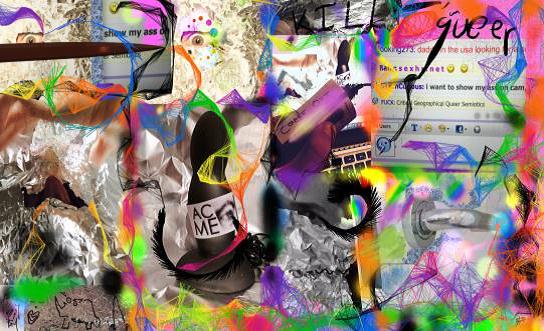
Critical Geographical Queer Semiotics

Autori

  • Martin Zebracki School of Geography, University of Leeds
  • Tommaso M. Milani University of Gothenburg and University of the Witwatersrand, Johannesburg, South Africa

DOI:

https://doi.org/10.14288/acme.v16i3.1602

Abstract

Introduction to themed section.


This Themed Section assembles sexuality/queer, geographical and socio-linguistic scholarship to pursue – what we, a collaborating geographer and semiotician, frame as –  critical geographical queer semiotics. We regard this as an on-going episteme-techne research frontier at the crossroads of language-focused geographical inquiry (see, e.g., Brown, 2002; Leap and Boellstorff, 2004; Valentine et al., 2008; Browne and Nash, 2010; Murray, 2016) and the unfolding sociolinguistic subdiscipline of linguistic landscaping (see, e.g., Shohamy and Gorter, 2009; Blommaert, 2013; Stroud and Jegels, 2014; Blackwood et al., 2016). 
Biografia autore

Martin Zebracki, School of Geography, University of Leeds

Dr Martin Zebracki is a cultural geographer in the Citizenship and Belonging Research Group in the School of Geography at the University of Leeds. With a human geography and art history background, he employs discursive, observational, participatory and multi-media methodologies to examine his intersecting core ethnographic interests in public art, social engagement and inclusiveness, queer citizenship and gender and sexual diversity within everyday in-vivo contexts of Western city spaces. Zebracki's recent area of concern is the emerging relevance of virtually mediated environments for multiscalar embodiment, public creative engagement and sexual identity performance.

##submission.downloads##

Pubblicato

2017-10-19

Come citare

Zebracki, M., & Milani, T. M. (2017). Critical Geographical Queer Semiotics. ACME: An International Journal for Critical Geographies, 16(3), 427–439. https://doi.org/10.14288/acme.v16i3.1602

Fascicolo

Sezione

Themed Section - Critical Geographical Queer Semiotics (Guest Eds. M. Zebracki and T. Milani)