
Introduction to the Themed Issue "Narratives of Displacements"
DOI :
https://doi.org/10.14288/acme.v19i1.1964Mots-clés :
Displacement, Gentrification, MigrationRésumé
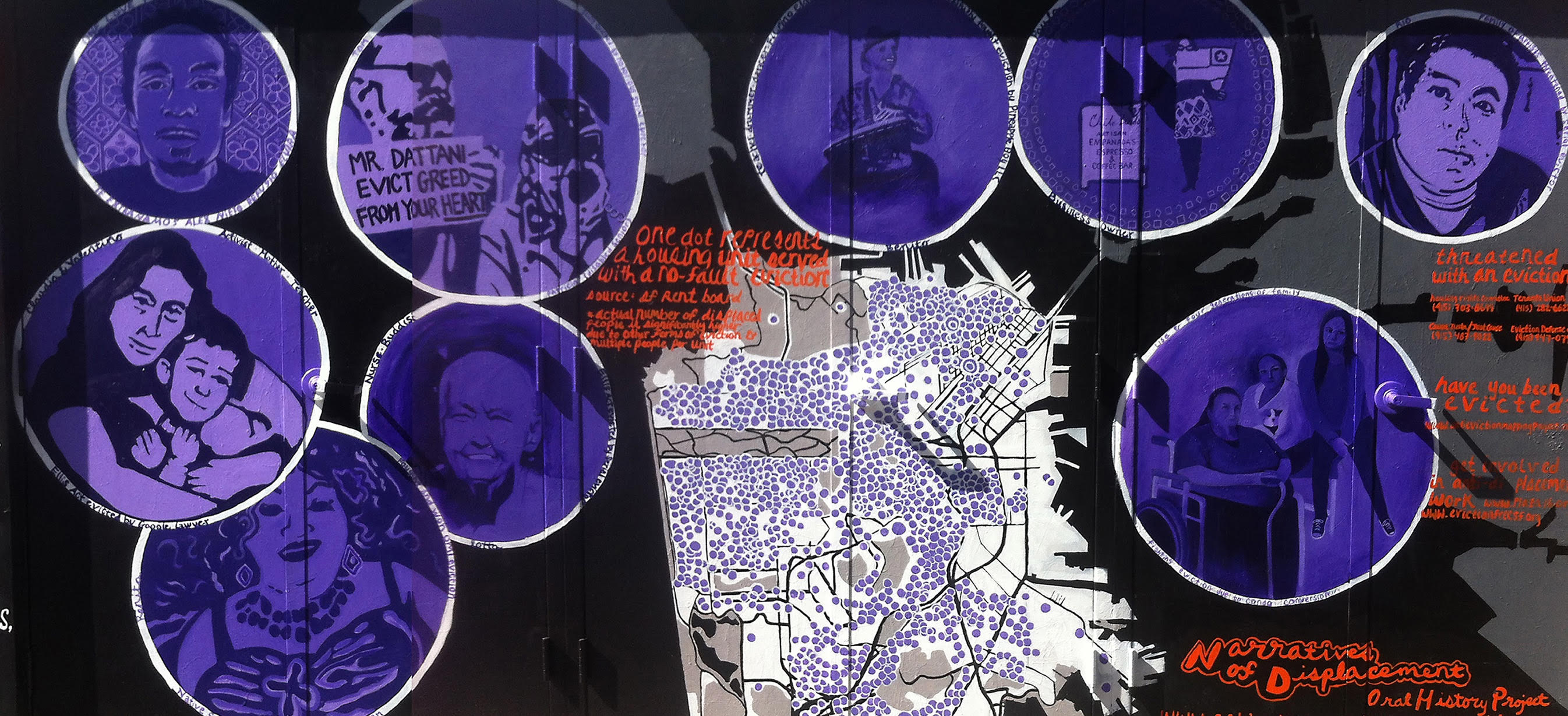
This is a themed issue about displacements. Or more precisely, about research grounded in narratives of people suffering displacement in its various forms, and their all too visible and yet oftentimes made-invisible demographics. ‘All too visible’ as those individuals or groups stand out either as scapegoats on which to lay blame for urban problems, or as the human fallout of ongoing processes of class struggles and racialised conflicts under neoliberal, neocolonial and neonationalist regimes of spatial encroachment. Yet, their subjectivity, agency and voice are invisibilised in public and political discourse, as well as in academic research, or they are altogether erased through the poor selection of methodologies that fail to capture the discrete statistical categories that can register displacement. Therefore, those afflicted by it become un-researchable. The papers within this themed issue collectively seek to re-center displacement, through investigations and narratives of displaced populations.
Références
Atkinson, Rowland. 2000. Measuring Gentrification and Displacement in Greater London. Urban Studies 37 (1), 149–65.
Butler, Tim. 2007. For Gentrification? Environment and Planning A 39 (1), 162–81.
Cartier, Carolyn. 2017. Contextual Urban Theory and the ‘Appeal’ of Gentrification, Lost in Transposition? International Journal of Urban and Regional Research 41 (3), 466–77.
Clark, Eric. 2006. On Blindness, Centrepieces and Complementarity in Gentrification Theory. Transactions of the Institute of British Geographers 17 (3), 358-62.
Davidson, Mark. 2009. Displacement , Space and Dwelling, Placing Gentrification Debate. Ethics, Place and Environment 12 (2), 219–34.
Davidson, Mark. 2011. Critical Commentary. Gentrification in Crisis, Towards Consensus or Disagreement? Urban Studies 48 (10), 1987–96.
Edwards, Natalie and Christopher Hogarth (eds) 2008. Gender and Displacement: Home in Contemporary Francophone Women’s Autobiography. Cambridge: Cambridge Scholars Publishing.
Escobar, Arturo. 2003. Displacement, Development, and Modernity in the Colombian Pacific. International Social Science Journal 55 (175), 157–67.
Freeman, Lance. 2005. Displacement or Succession? Residential Mobility in Gentrifying Neighborhoods. Urban Affairs Review 40 (4), 463–91.
Freeman, Lance, Adele, Cassola, and Tiancheng Cai. 2016. Displacement and Gentrification in England and Wales: A Quasi-Experimental Approach. Urban Studies 53 (13), 2797–2814.
Ghertner, D. Asher. 2014. India’s Urban Revolution: Geographies of Displacement beyond Gentrification. Environment and Planning A 46 (7): 1554–71.
Grier, George and Grier, Eunice. 1980 Urban Displacement: A Reconnaissance. In, Laska, Shirly and Spain, Daphne (eds.), Back to the City: Issues in Neighborhood Renovation. Oxford: Pergamon Press, pp. 252-68.
Hartman, Chester W., Keating, T. Dennis and LeGates, Richard T. 1982. Displacement, How to Fight It. Berkeley: National Housing Law Project.
Helbrecht, Ilse. 2018. Gentrification and Displacement. In, Helbrecht, Ilse (ed.), Gentrification and Resistance: Researching Displacement Processes and Adaption Strategies. Wiesbaden: Springer, pp. 1-7.
Kearns, Ade and Mason, Phil. 2013. Defining and Measuring Displacement: Is Relocation from Restructured Neighbourhoods Always Unwelcome and Disruptive? Housing Studies 28 (2), 177-204.
Kohn, Margaret. 2013. What Is Wrong with Gentrification? Urban Research & Practice 6 (3), 297-310.
Maloutas, Thomas. 2018. Travelling Concepts and Universal Particularisms: A Reappraisal of Gentrification’s Global Reach. European Urban and Regional Studies 25 (3), 250–65.
Marcuse, Peter. 1985. Gentrification, Abandonment, and Displacement: Connections, Causes, and Policy Responses in New York City. Washington University Journal of Urban and Contemporary Law 28, 195-240.
McKinnish, Terra, Randall Walsh, and Kirk T. White. 2010. Who Gentrifies Low-Income Neighborhoods? Journal of Urban Economics 67 (2), 180–93.
McLean, Heather. 2014. Digging into the Creative City: A Feminist Critique. Antipode 46 (3), 669–90.
Meltzer, Rachel, and Pooya Ghorbani. 2017. Does Gentrification Increase Employment Opportunities in Low-Income Neighborhoods? Regional Science and Urban Economics 66, 52-73.
Newman, Kathe, and Elvin Wyly. 2006. The Right to Stay Put, Revisited: Gentrification and Resistance to Displacement in New York City. Urban Studies 43 (1), 23–57.
Pull, Emil, and Åse Richard. 2019. Domicide: Displacement and Dispossessions in Uppsala, Sweden. Social and Cultural Geography. Online first. https://doi.org/10.1080/14649365.2019.1601245
Sims, J. Revel. 2015. More than Gentrification: Geographies of Capitalist Displacement in Los Angeles 1994–1999. Urban Geography 37 (July), 1–31.
Slater, Tom. 2006. The Eviction of Criticial Perspectives from Gentrification Research. International Journal of Urban and Regional Research 30 (4), 737–57.
Slater, Tom. 2009. Missing Marcuse: On Gentrification and Displacement. City 13 (2–3), 292–311.
UNDP. 2017. Migration and Displacement. 2017.
Valli, Chiara. 2015. A Sense of Displacement: Long-Time Residents’ Feelings of Displacement in Gentrifying Bushwick, New York. International Journal of Urban and Regional Research 39 (6), 1191–1208.
Vigdor, Jacob L. 2002. Does Gentrification Harm the Poor? Brookings-Wharton Papers on Urban Affairs 2002 (1), 133–82.
Vigdor, Jacob L. 2010. Is Urban Decay Bad? Is Urban Revitalization Bad Too? Journal of Urban Economics 68 (3), 277–89.
Wacquant, Loïc. 2008. Relocating Gentrification: The Working Class, Science and the State in Recent Urban Research. International Journal of Urban and Regional Research 32 (1), 198–205.
Wright, Melissa W. 2014. The Gender, Place and Culture Jan Monk Distinguished Annual Lecture: Gentrification, Assassination and Forgetting in Mexico: A Feminist Marxist Tale. Gender, Place and Culture 21 (1), 1–16.
Téléchargements
Publié-e
Comment citer
Numéro
Rubrique
Licence
Les auteur-e-s publiant dans ACME le font aux conditions de la licence canadienne Creative Commons "Attribution/Non-Commercial/No Derivative Works". En conséquence, les auteur-e-s gardent les droits sur leur texte, ainsi que celui d'être identifié-e-s comme auteur-e-s sans limitation de date. Leur texte peut être partagé librement (soit reproduit, distribué, transmis et publié) dans les conditions suivantes :
- Attribution. La publication originale de ladite oeuvre dans ACME doit être mentionnée et, pour tout usage ou distribution, les termes de sa licence doivent être précisés.
- Non commercial. L'oeuvre ne peut être utilisée à des fins commerciales.
- Pas de travaux dérivés. À l'exception d'usages légitimes dans des buts universitaires ou critiques, l'oeuvre ne peut être altérée ou transformée. À l'exception de la première condition d'attribution à ACME de la publication originale, toutes ces conditions peuvent être levées avec la permission explicite du détenteur du copyright.
(Note: du volume 1(1) au volume 7(2), les auteur-e-s ont donné à ACME un copyright sur leur article limité à la publication dans la revue. Les auteur-e-s gardent le copyright sur leur manuscrit pour toute autre forme de publication, mais doivent mentionner la publication originale dans ACME si le texte est republié ailleurs).
Pour une publication dans ACME, les auteur-e-s déclarent que et se portent garant-e-s que
- leur article est une oeuvre originale, n'a pas été publié avant et n'est pas soumis ailleurs pour publication papier ou électronique sous sa forme finale ;
- Illes ont obtenu l'autorisation de reproduction (papier et électronique) de la part du possesseur des droits de copyright pour tout le matériau qui ne leur appartient pas, et que le possesseur est cité comme source ;
- Leur article ne contient aucun élément violant un copyright existant, le droit d'un tiers, ou quoi que ce soit de nature obscène, indécente, calomniatrice ou en quelque façon illégale ; et, qu'en l'état de leurs connaissance, leur article n'empiète sur les droit de personne.
- Ils ont la charge d'indemniser les rédacteurs et éditeurs d'ACME pour toutes poursuites afférentes à un non respect desdites garanties, indemnisations comprenant l'aide justiciaire et les autres dépenses encourues.
- Dans le cas d'un article avec des multiples auteur-e-s, illes ont obtenu l'accord de tou-te-s les auteur-e-s pour ce contrat d'édition, qui les lie ; et que tou-te-s les auteur-e-s ont lu et approuvé le contrat ci-dessus.