
Terraqueous Necropolitics
Unfolding the Low-operational, Forensic, and Evocative Mapping of Mediterranean Sea Crossings in the Age of Lethal Borders
DOI :
https://doi.org/10.14288/acme.v18i6.1829Mots-clés :
Necropolitics, Mediterranean Sea, migration, visual culture, critical cartography, terraqueuos spaceRésumé
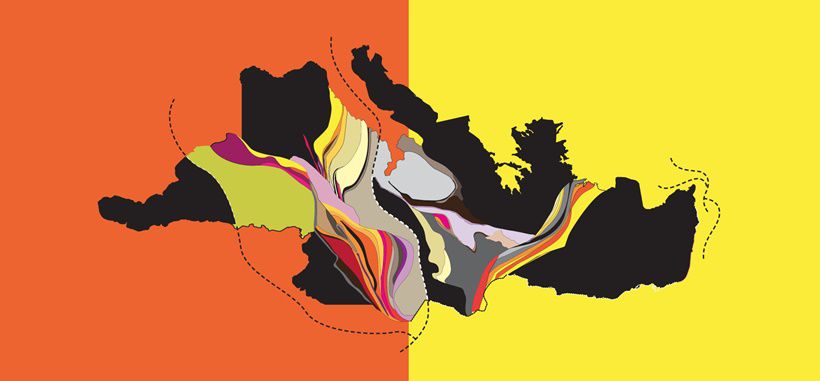
Over the last years, the European Union (EU)’s anti-immigration policy has shifted the imagery of the Mediterranean Sea from a lifeworld into a deathworld. The ensuing media attention on migration across the sea has resulted in the dramatic proliferation of images exhibiting human suffering and death. These images include maps, which have been barely discussed by critical scholars. This paper narrows this gap by examining the relationship between the lethal policies affecting the Central Mediterranean Migration Route and its maps. It introduces the terraqueous necropolitics as a new framework of analysis, by acknowledging the power to kill that EU is exerting over an amphibious space, that is, through the blocking of migrants on the firm land and the intentional inaction in sea rescues. This power is also perpetrated by the media representation of migrants as quasi-objects. On the other hand, due to the multivocal relations of cartography with marine territoriality and what I call “the geometry of the unliving,” I draw on three case studies on mapping and migration to explore the modes through which maps produce, expose or evoke the necropolitics of the Mediterranean Sea. I frame these “mapshots” through three interpretive categories: low-operational, forensic and evocative mapping. These visual and spatial regimes of investigation require interdisciplinary attention on the distinctiveness among cartographic events and the configuration of the terraqueous border they enact.
Références
Amoore, Louise. 2007. Vigilant visualities: The watchful politics of the war on terror. Security Dialogue, 38(2), 215–32.
Anderson, Ben and Paul Harrison (eds). 2010. Taking-place: Non-representational Theories and Geography. London: Ashgate.
Anderson, Jon and Kimberley Peters (eds). 2014. Water Worlds: Human Geographies of the Ocean. London/New York: Routledge.
Ashutosh, Ishan and Alison Mountz. 2012. The geopolitics of migrant mobility: Tracing state relations through refugee claims, boats, and discourses. Geopolitics, 17, 335–354.
Bacon, Lucie, Olivier Clochard, Thomas Honoré, Nicolas Lambert, Sarah Mekdjian, and Philippe Rekacewicz. 2016. Mapping the Migratory Movements. Revue Eeuropéenne des Migrations Internationales, 32 (3-4): https://journals.openedition.org/remi/8803
Bashford, Alison. 2017. Terraqueous Histories. The Historical Journal, 60(2), 253–272.
Berlant, Lauren. 2007. Slow Death (Sovereignty, Obesity, Lateral Agency). Critical Inquiry, 33, 754–80.
Bialasiewicz, Luiza. 2012. Off-shoring and out-sourcing the borders of EUrope: Libya and EU border work in the Mediterranean. Geopolitics, 17, 843–866.
Bischoff, Christine, Francesca Falk, and Sylvia Kafehsy. 2010. Images of Illegalized Immigration: Towards a Critical Iconography of Politics. New Brunswick and London: Transaction Publishers.
Blais, Hélène and Florence Deprest. 2012. The Mediterranean, a territory between France and Colonial Algeria: imperial constructions. European Review of History: Revue Européenne D’histoire, 19(1), 33–57.
Bleiker, Roland, David Campbell, Emma Hutchison, and Xzarina Nicholson. 2013. The visual dehumanisation of refugees. Australian Journal of Political Science, 48(3), 398–416.
Boria, Edoardo and Tania Rossetto. 2017. The Practice of Mapmaking: Bridging the Gap between Critical/Textual and Ethnographical Research Methods. Cartographica, 52(1), 32–48.
Braidotti, Rosi. 2007. Biomacht und nekro-Politik. Überlegungen zu einer Ethik der Nachhaltigkeit, Springerin, Hefte fur Gegenwartskunst, 13(2), 18–23.
Braudel, Fernand. (1948). Il Mediterraneo. Milan: Bompiani.
Brian, Tara and Frank Laczko. 2016. Fatal Journeys: Identification and Tracing of Dead and Missing Migrants. Geneva: IOM.
Browne, Simone. 2010. Digital Epidermalization: Race, Identity and Biometrics. Critical Sociology, 36(1), 131–150.
Canali, Laura. 2015. Il Mediterraneo non è più liquido. E non è più poetico. Limesonline, http://www.limesonline.com/rubrica/il-mediterraneo-non-e-piu-liquido-enon-e-piu-poetico. (last accessed 13 December 2018).
Casas-Cortés, Maribel, Sebastian Cobarrubias, Charles Heller, and Lorenzo Pezzani. 2017. Clashing Cartographies, Migrating Maps: The Politics of Mobility at the External Borders of E.U.Rope. ACME, 16(1), 1–33.
Crampton, Jeremy W. 2003. The Political Mapping of Cyberspace. Edinburgh: Edinburgh University Press.
Cuttitta, Paolo. 2018. Inclusion and Exclusion in the Fragmented Space of the Sea. Actors, Territories and Legal Regimes between Libya and Italy. In E. Burroughs and K. Williams (eds), Contemporary Boat Migration: Data, Geopolitics and Discourses, Rowman & Littlefield: Lanham, pp. 75–94.
Davies, Thom, Arshad Isakjee, and Surindar Dhesi. 2017. Violent inaction: the necropolitical experience of refugees in Europe. Antipode, 49(5), 1263–84.
Delaney, David. 2005. Territory: A Short Introduction. Oxford: Blackwell.
Deleuze, Gilles and Félix Guattari. 1988. A thousand plateaus: Capitalism and schizophrenia. London: Bloomsbury Publishing.
Della Dora, Veronica. 2010. Mapping Metageographies: The Cartographic Invention of Italy and the Mediterranean. California Italian Studies, 1(1), 1–25.
Dodge, Martin, Rob Kitchin, and Chris Perkins. 2009. Rethinking Maps: New Frontiers in Cartographic Theory. London/New York: Routledge.
Doty, Roxanne Lynn. 2011. Bare life: border-crossing deaths and spaces of moral alibi. Environment and Planning D: Society and Space, 29, 599–612.
Esposito, Roberto. 2016. Da fuori. Una filosofia per l’Europa. Turin: Einaudi.
Foucault, Michel. 1985. Discourse and Truth: the Problematization of Parrhesia. Evanston, IL: Northwestern University Press.
Foucault, Michel. 1990. The History of Sexuality Volume 1: An Introduction. New York: Vintage Books.
Gilroy, Paul. 2000. Against Race: Imagining Political Culture Beyond the Color Line. Cambridge, MA: The Harvard University Press.
Giubilaro, Chiara. 2017. Shooting Borders: Per una geografia visuale delle migrazioni. Rivista Geografica Italiana, 127, 315–336.
Heller, Charles and Lorenzo Pezzani. 2014. Liquid Traces: Investigating the Deaths of Migrants at the EU’s Maritime frontier. In Weizman, Eyal (ed.): Forensis. The Architecture of Public Truth, Berlin: Sternberg Press, pp. 656–684.
Heller, Charles and Lorenzo Pezzani. 2016. Ebbing and Flowing: The EU’s Shifting Practices of (Non) Assistance and Bordering in a Time of Crisis, Near Futures Online, 1–33.
Holert, Tom. 2019. Epistemic Violence and the Careful Photograph, e-flux, 96: https://www.e-flux.com/journal/96/243357/epistemic-violence-and-the-careful-photograph/
Jones, Reece. 2015. The Mediterranean: international region and deadly border. Nordia, 44(4), 37–42.
Lo Presti, Laura. 2018. Post(mortem) Cartographies: Reframing the cartographic exhaustion in the age of mapping’s excess. In Pol Bargués-Pedreny, David Chandler, Elena Simon (eds): Mapping and Politics in the Digital Age, London/New York: Routledge, pp. 165–182.
Loyd, Jenna M. and Alison Mountz. 2014. Managing migration, scaling sovereignty on islands. Island Studies Journal, 9, 23–42.
Mainwaring, Ċetta and Noelle Brigden. 2016. Beyond the border: Clandestine journeys. Geopolitics, 21(2), 243–262.
Mbembe, Achille. 2003. Necropolitics. Public Culture, 15(1), 11–40.
McKittrick, Katherine. 2014. Mathematics Black Life. The Black Scholar, 44(2), 16–28.
McMahon, Simon and Nando Sigona. 2018. Navigating the Central Mediterranean in a Time of ‘Crisis’: Disentangling Migration Governance and Migrant Journeys. Sociology, 52(3), 497–514.
Mountz, Alison. 2011. The enforcement archipelago: Detention, haunting, and asylum on islands. Political Geography, 30, 118–128.
Paoletti, Emanuela. 2010. The Migration of Power and North-South Inequalities. The Case of Italy and Libya. Basingstoke: Palgrave Macmillan.
Perkins, Chris. 2004. Cartography-cultures of mapping: power in practice. Progress in Human Geography, 28(3), 381–391.
Peters, Kimberley, Philip Steinberg, and Elaine Stratford (eds). 2018. Territory Beyond Terra, London/ New York: Rowman & Littlefield International.
Rossetto, Tania. 2019. Object-Oriented Cartography: Maps as Things, London/New York: Routledge.
Savage-Smith, Emilie. 2014. ‘Cartography’. In, Horden Peregrine and Sharon Kinoshita (eds). A Companion to Mediterranean History, Oxford: Wiley-Blackwell, pp. 184–199.
Soderlund, Gretchen. 2013. Introduction to “charting, tracking, and mapping”: new technologies, labor, and surveillance. Social Semiotics, 23(2), 163–172.
Spijkerboer, Thomas. 2007. The Human Costs of Border Control. European Journal of Migration and Law, 9(1), 127–139.
Squire, Vicky. 2017. Governing Migration Through Death in Europe and the US: Identification, Burial and the Crisis of Modern Humanism. European Journal of International Relations, 23(3), 513–532.
Steinberg, Philip and Kimberley Peters. 2015. Wet ontologies, fluid spaces: Giving depth to volume through oceanic thinking. Environment and Planning D: Society and Space, 33(2), 247–264.
Stierl, Maurice. 2016. A sea of struggle–activist border interventions in the Mediterranean Sea. Citizenship Studies, 20(5), 561–578.
Tazzioli, Martina. 2015. Which Europe? Migrants’ uneven geographies and counter-mapping at the limits of representation, Movements. Journal for Critical Migration and Border Regime Studies, 1(2): http://movements-journal.org/issues/02.kaempfe/04.tazzioli--europe-migrants-geographies-counter-mapping-representation.html.
Tazzioli, Martina. 2016. Eurosur, Humanitarian Visibility, and (Nearly) Real-time Mapping in the Mediterranean. ACME, 15(3), 561–579.
The Migrants’ Files: http://www.themigrantsfiles.com/ (last accessed 15 December 2018).
Weber, Leanne and Sharon Pickering. 2011. Globalization and Borders: Death at the Global Frontier. New York: Palgrave Macmillan.
Weizman, Eyal. 2014. Forensis: The Architecture of Public Truth. Berlin: Sternberg Press.
Téléchargements
Publié-e
Comment citer
Numéro
Rubrique
Licence
Les auteur-e-s publiant dans ACME le font aux conditions de la licence canadienne Creative Commons "Attribution/Non-Commercial/No Derivative Works". En conséquence, les auteur-e-s gardent les droits sur leur texte, ainsi que celui d'être identifié-e-s comme auteur-e-s sans limitation de date. Leur texte peut être partagé librement (soit reproduit, distribué, transmis et publié) dans les conditions suivantes :
- Attribution. La publication originale de ladite oeuvre dans ACME doit être mentionnée et, pour tout usage ou distribution, les termes de sa licence doivent être précisés.
- Non commercial. L'oeuvre ne peut être utilisée à des fins commerciales.
- Pas de travaux dérivés. À l'exception d'usages légitimes dans des buts universitaires ou critiques, l'oeuvre ne peut être altérée ou transformée. À l'exception de la première condition d'attribution à ACME de la publication originale, toutes ces conditions peuvent être levées avec la permission explicite du détenteur du copyright.
(Note: du volume 1(1) au volume 7(2), les auteur-e-s ont donné à ACME un copyright sur leur article limité à la publication dans la revue. Les auteur-e-s gardent le copyright sur leur manuscrit pour toute autre forme de publication, mais doivent mentionner la publication originale dans ACME si le texte est republié ailleurs).
Pour une publication dans ACME, les auteur-e-s déclarent que et se portent garant-e-s que
- leur article est une oeuvre originale, n'a pas été publié avant et n'est pas soumis ailleurs pour publication papier ou électronique sous sa forme finale ;
- Illes ont obtenu l'autorisation de reproduction (papier et électronique) de la part du possesseur des droits de copyright pour tout le matériau qui ne leur appartient pas, et que le possesseur est cité comme source ;
- Leur article ne contient aucun élément violant un copyright existant, le droit d'un tiers, ou quoi que ce soit de nature obscène, indécente, calomniatrice ou en quelque façon illégale ; et, qu'en l'état de leurs connaissance, leur article n'empiète sur les droit de personne.
- Ils ont la charge d'indemniser les rédacteurs et éditeurs d'ACME pour toutes poursuites afférentes à un non respect desdites garanties, indemnisations comprenant l'aide justiciaire et les autres dépenses encourues.
- Dans le cas d'un article avec des multiples auteur-e-s, illes ont obtenu l'accord de tou-te-s les auteur-e-s pour ce contrat d'édition, qui les lie ; et que tou-te-s les auteur-e-s ont lu et approuvé le contrat ci-dessus.