
Data for Justice
Tensions and Lessons from the Anti-Eviction Mapping Project’s Work Between Academia and Activism
DOI :
https://doi.org/10.14288/acme.v19i1.1776Mots-clés :
Scholar-activism, Displacement, Housing justice, Feminist/decolonial epistemology, Mutual aid, RedistributionRésumé
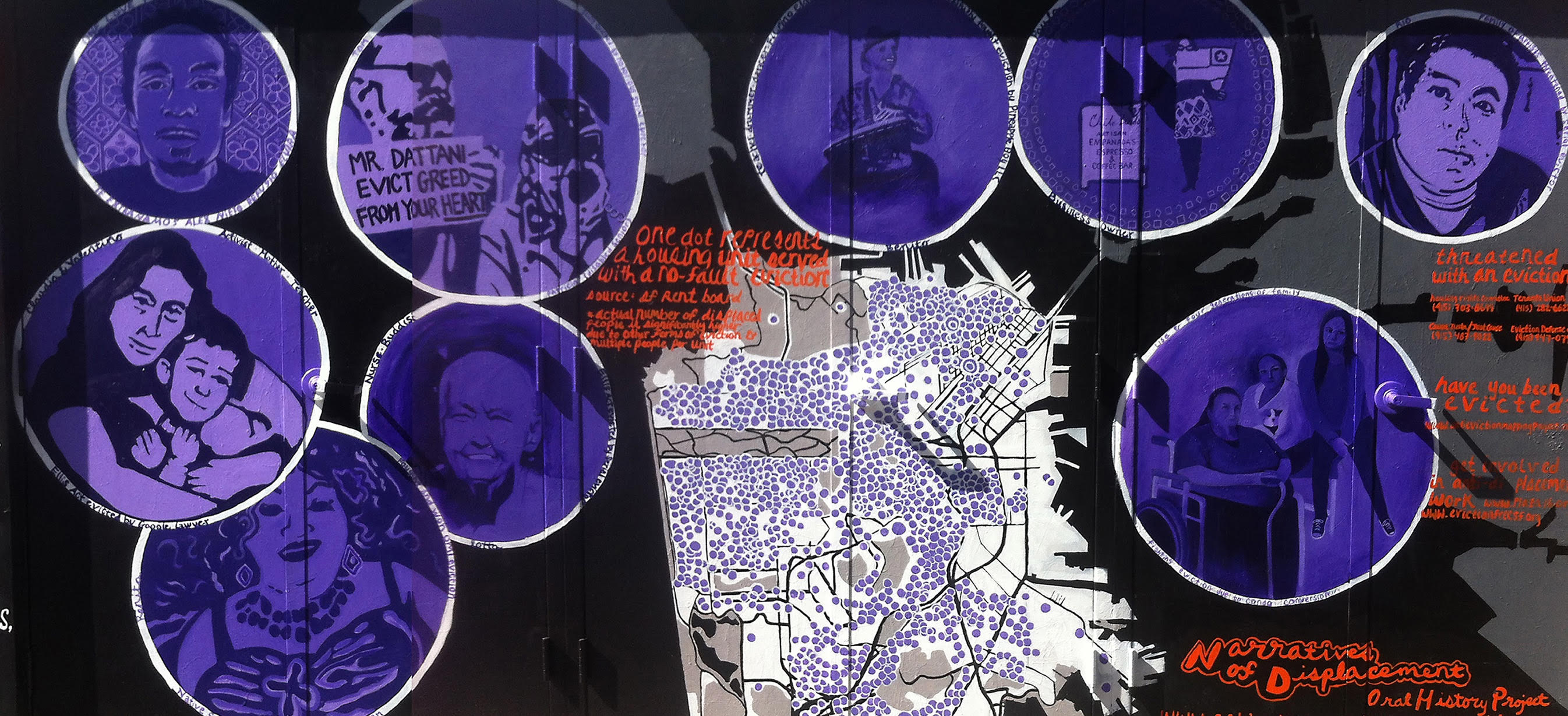
What does it mean to do community engaged research as a scholar-activist? The Anti-Eviction Mapping Project (AEMP) is a project grounded in a critical orientation towards academic knowledge production. Instead of producing data for the academy, the scholars within AEMP see themselves as producing data for justice. The authors reflect on how, over the course of the project, AEMP has discovered the challenges of straddling the unequal terrain between academia and activism and offer three principles which have become key to AEMP’s own navigation of this academia-activism divide: mutual aid, accountability, and embeddedness.
Références
Anti-Eviction Mapping Project. 2018. AEMP Handbook. In, Moshoula Capous-Desyllas and Karen Morgaine (eds.), Creating Social Change Through Creativity. London: Palgrave Macmillan, pp. 289-308.
Brown, Wendy. 2011. Neoliberalized Knowledge. History of the Present 1, 113-129.
Burns, Ryan, Craig Dailton and Jim Thatcher. 2018. Critical Data, Critical Technology in Theory and Practice. The Professional Geographer 70, 126-8.
Chakrabarty, Dipesh. 2000. Provincializing Europe: Postcolonial Thought and Historical Difference. Princeton: Princeton University Press.
Counter Cartographies Collective, Craig Dalton and Liz Mason-Deese. 2012. Counter (Mapping) Actions: Mapping as Militant Research. ACME: An International E-Journal for Critical Geographies 11, 439-66.
Dalton, Craig and Tim Stallmann. 2018. Counter-mapping data science. Canadian Geographer 62, 93-101.
Dozier, Deshonay. 2018. A Response to Abolitionist Planning: There’s No Room for ‘Planners’ in the Movement for Abolition. Progressive City. 9 August 2018. Accessed 30 September 2018 <https://www.progressivecity.net/single-post/2018/08/09/A-RESPONSE-TO-ABOLITIONIST-PLANNING-THERE-IS-NO-ROOM-FOR-‘PLANNERS’-IN-THE-MOVEMENT-FOR-ABOLITION>.
Elwood, Sarah. 2006. Beyond Cooptation or Resistance: Urban Spatial Politics, Community Organizations, and GIS-Based Spatial Narratives. Annals of the Association of American Geographers 96, 323–41.
Gieseking, Jen Jack. 2018. Operating anew: Queering GIS with good enough software. Canadian Geographer 62, 55-66.
Graziani, Terra, Erin McElroy, Mary Shi and Leah Simon-Weisberg. 2016. Counterpoints: Data and Stories for Resisting Displacement. Report published by the Anti-Eviction Mapping Project in San Francisco.
Haraway, Donna. 1988. Situated Knowledges: The Science Question in Feminism and the Privilege of Partial Perspective. Feminist Studies 14, 575-99.
Harding, Sandra. 2005. Negotiating with the Positivist Legacy: New Social Justice Movements and a Standpoint Politics of Method. In, George Steinmetz (ed.), The Politics of Method in the Human Sciences: Positivism and Its Epistemological Others. Durham: Duke University Press, pp. 346-65.
Harney, Stefano and Fred Moten. 2013. The Undercommons: Fugitive Planning and Black Study. New York: Minor Compositions.
INCITE. 2007. The Revolution Will Not be Funded: Beyond the Nonprofit Industrial Complex. Cambridge, Mass: South End Press.
Kent, Andy, Chris Knudson, Rich Heyman, Jim Thatcher, Andrew Newson, Sara Safransky, Alex Hill, and Bob Colenutt. 2017. Symposium – The Detroit Geographical Expedition and Institute Then and Now: Commentaries on ‘Field Notes No.4: The Trumbull Community.’ AntipodeFoundation.org. Accessed 16 March 2019 <https://antipodefoundation.org/2017/02/23/dgei-field-notes/>.
Kwan, Mei-Po. 2002. Feminist Visualization: Re-Envisioning GIS as a Method in Feminist Geographic Research. Annals of the Association of American Geographers 92, 645-61.
Maharawal, Manissa M. and Erin McElroy. 2018. The Anti-Eviction Mapping Project: Counter Mapping and Oral History towards Bay Area Housing Justice. Annals of the American Association of Geographers 108, 380-9.
McElroy, Erin. 2016. Intersectional Contours of Loss and Resistance: Mapping Bay Area Gentrification. AntipodeFoundation.org. Accessed 21 September 2018 <https://antipodefoundation.org/2016/08/18/intersectional-contours-of-loss-and-resistance/>.
McElroy, Erin. 2018. Countermapping Displacement and Resistance in Alameda County with the Anti-Eviction Mapping Project. American Quarterly 70, 601-4.
Roy, Ananya, Stuart Schrader and Emma Shaw Crane. 2015. The Anti-Poverty Hoax: Development, Pacification, and the Making of Community in the Global 1960s. Cities 44, 139-45.
Ryan, Charlotte. 2004. Can We Be Compañeros? Social Problems 51, 110-3.
Spivak, Gayatri. 1988. Can the Subaltern Speak? In, Cary Nelson and Lawrence Grossberg (eds.), Marxism and the Interpretation of Culture. Urbana: University of Illinois Press, pp. 271-313.
Sweet, Paige. 2018. The Feminist Question in Realism. Sociological Theory 36, 221–43.
Téléchargements
Publié-e
Comment citer
Numéro
Rubrique
Licence
Les auteur-e-s publiant dans ACME le font aux conditions de la licence canadienne Creative Commons "Attribution/Non-Commercial/No Derivative Works". En conséquence, les auteur-e-s gardent les droits sur leur texte, ainsi que celui d'être identifié-e-s comme auteur-e-s sans limitation de date. Leur texte peut être partagé librement (soit reproduit, distribué, transmis et publié) dans les conditions suivantes :
- Attribution. La publication originale de ladite oeuvre dans ACME doit être mentionnée et, pour tout usage ou distribution, les termes de sa licence doivent être précisés.
- Non commercial. L'oeuvre ne peut être utilisée à des fins commerciales.
- Pas de travaux dérivés. À l'exception d'usages légitimes dans des buts universitaires ou critiques, l'oeuvre ne peut être altérée ou transformée. À l'exception de la première condition d'attribution à ACME de la publication originale, toutes ces conditions peuvent être levées avec la permission explicite du détenteur du copyright.
(Note: du volume 1(1) au volume 7(2), les auteur-e-s ont donné à ACME un copyright sur leur article limité à la publication dans la revue. Les auteur-e-s gardent le copyright sur leur manuscrit pour toute autre forme de publication, mais doivent mentionner la publication originale dans ACME si le texte est republié ailleurs).
Pour une publication dans ACME, les auteur-e-s déclarent que et se portent garant-e-s que
- leur article est une oeuvre originale, n'a pas été publié avant et n'est pas soumis ailleurs pour publication papier ou électronique sous sa forme finale ;
- Illes ont obtenu l'autorisation de reproduction (papier et électronique) de la part du possesseur des droits de copyright pour tout le matériau qui ne leur appartient pas, et que le possesseur est cité comme source ;
- Leur article ne contient aucun élément violant un copyright existant, le droit d'un tiers, ou quoi que ce soit de nature obscène, indécente, calomniatrice ou en quelque façon illégale ; et, qu'en l'état de leurs connaissance, leur article n'empiète sur les droit de personne.
- Ils ont la charge d'indemniser les rédacteurs et éditeurs d'ACME pour toutes poursuites afférentes à un non respect desdites garanties, indemnisations comprenant l'aide justiciaire et les autres dépenses encourues.
- Dans le cas d'un article avec des multiples auteur-e-s, illes ont obtenu l'accord de tou-te-s les auteur-e-s pour ce contrat d'édition, qui les lie ; et que tou-te-s les auteur-e-s ont lu et approuvé le contrat ci-dessus.